

Events production services are the technical and creative gears turning behind the scenes to bring an event to life. Think of them as the ‘how’ behind a knockout corporate conference, product launch, or immersive brand experience. They fuse everything from audio-visuals and lighting to set design and logistics into one seamless, show-stopping operation.
What Are Events Production Services?
Here’s a good way to think about it: imagine your event is a blockbuster film. The event planner is the executive producer, the one who sets the vision, budget, and overall strategy. The events production company, on the other hand, is the film’s director, crew, and special effects team all rolled into one. They are the hands-on architects and engineers responsible for crafting the tangible, sensory elements your audience will see, hear, and feel.
This goes way beyond just setting up a few speakers and a projector. True event production is about creating an environment. It’s the art and science of turning a conceptual brief into a physical, engaging, and flawless reality. These specialists are the masters of execution, ensuring every technical and creative component works in perfect harmony.
From Blueprint to Reality
The journey starts by translating a big idea into a workable plan. A production team will take a creative vision, analyse it, and then reverse-engineer it into a series of technical and logistical tasks.
This means finding answers to critical, real-world questions like:
- What kind of stage design will best support the keynote speaker?
- How can we use lighting to transform a standard hotel ballroom into a tropical jungle?
- What audio gear do we need to guarantee crystal-clear sound for every single person in a 500-seat auditorium?
- How can we build a custom branded entrance that makes an immediate, unforgettable impact on guests?
This meticulous planning ensures the final result isn’t just functional, but also emotionally resonant and perfectly aligned with the event’s goals.
“Event production is the bridge between imagination and experience. It’s the craft of making sure the spectacular vision in your head is the same spectacular reality your attendees walk into.”
Core Components of Production
While the specifics change with every event, professional events production services are built on a foundation of several key disciplines. These components work together to create a cohesive and immersive atmosphere.
To give you a clearer picture, here’s a breakdown of the primary disciplines involved in bringing an event to life. Each one has a distinct role, but they all need to work in concert for a truly successful outcome.
Core Components of Events Production at a Glance
| Component | Description | Key Objective |
|---|---|---|
| Audio-Visual (AV) | The management of all sound, video, and projection technology. | To ensure every message is clearly seen and heard by the audience. |
| Staging & Set Design | The physical construction of the event’s environment, including stages, backdrops, and props. | To create a focal point and build the world of the event. |
| Lighting Design | The strategic use of light to create mood, direct attention, and enhance aesthetics. | To shape the atmosphere and guide the audience’s experience. |
| Logistics & Technical | The behind-the-scenes management of equipment, crew, power, and safety. | To guarantee a seamless, safe, and technically flawless execution. |
Ultimately, it’s the skillful integration of these elements that separates a good event from a great one.
The demand for these specialised skills is certainly on the rise. The United Kingdom’s event industry market size was recently valued at approximately USD 80.21 billion. What’s more, forecasters predict it will expand at a compound annual growth rate of 4.92% over the next decade, as detailed in this UK event market growth report on sphericalinsights.com. This growth reflects an increasing understanding that professional production isn’t a luxury it’s a necessity for any event that aims to make a real impact.

The Four Pillars of Event Production
To get a real handle on professional events production services, it helps to picture the whole process being held up by four distinct, yet interconnected, pillars. Think of it like the columns supporting a grand building each one is critical for the structure’s integrity. If one is weak, the entire thing risks becoming unstable. These pillars Audio-Visual Production, Staging and Set Design, Lighting Design, and Event Theming are the bedrock elements that turn an empty room into an immersive world.
When these four work in harmony, they create a powerful, cohesive experience. A flashy product launch might lean heavily on dazzling AV and a futuristic set, while a corporate gala could focus more on sophisticated lighting and elegant theming. Let’s break down each pillar to see how it contributes to a flawless event.
Audio-Visual Production: The Sights and Sounds
Audio-Visual (AV) production is the technical backbone of any modern event. It’s the pillar that makes sure your message isn’t just delivered, but seen and heard with absolute clarity and impact. In short, it’s the central nervous system of your event, transmitting vital information to every single attendee.
Poor AV is one of the fastest ways to kill an event’s vibe. If a speaker’s microphone crackles, a video presentation lags, or the screens are too small, the audience tunes out almost immediately. Professional AV production sidesteps these disasters by meticulously planning and executing every audio and visual detail.
This includes:
- Sound Systems: Engineering crystal-clear audio with high-quality microphones for presenters, perfectly balanced sound for music, and consistent volume levels that reach every corner of the venue.
- Visual Displays: Implementing everything from huge LED video walls for a stunning backdrop to strategically placed screens and projectors, making sure no one misses a thing.
- Live Feeds and Recording: Managing camera crews for live image magnification (IMAG), so even people in the back row feel like they’re in the front. It also involves recording content for you to use later.
Ultimately, brilliant AV production makes the technology feel invisible. It just works, letting the audience focus completely on the content and the experience. That’s the hallmark of a true professional.
Staging and Set Design: Building Your World
While AV delivers the message, staging and set design create the world that message lives in. This pillar is the architectural and structural foundation of your event’s physical environment. It’s all about building the stage, the backdrop, and the physical elements that shape how your audience sees and feels the space.
A stage is so much more than a raised platform; it’s the focal point of the entire event. Its design directly impacts how the audience connects with what’s happening on it. A bare stage feels flat and uninspiring, but a custom-designed set can reinforce your brand’s identity and make the whole presentation far more memorable.
Staging and set design are where creativity meets construction. It’s the process of turning a flat floor plan into a three-dimensional, branded environment that guides attention and supports the event’s narrative.
A professional production company, like Boo Productions, handles every bit of this, from the first concept sketches and 3D models to the final build and installation. This could mean a sleek, minimalist stage for a tech conference or an elaborate, multi-level set for a theatrical awards show. Branded backdrops, custom lecterns, and unique entranceways all fall under this pillar, making sure the physical space is every bit as compelling as the event itself.
Lighting Design: Crafting the Atmosphere
If staging builds the world, lighting design paints it with emotion and focus. This is easily one of the most powerful and often underestimated elements in event production. Lighting does more than just make a room visible; it sculpts the environment, directs the audience’s gaze, and creates a specific mood.
Think of a lighting designer as an artist whose medium is light. They use colour, intensity, and movement to turn a generic venue into something truly special. For instance, warm, soft lighting can create an intimate and elegant feel for a gala dinner. In contrast, dynamic, colourful, and fast-moving lights generate excitement and energy for a product launch or concert.
Effective lighting design also serves a practical purpose.
- Guiding Focus: Spotlights can draw every eye to a keynote speaker, while uplighting can highlight architectural features or branded elements.
- Defining Spaces: Different lighting schemes can visually separate zones in a large venue, like a reception area, a networking lounge, and the main stage.
- Enhancing Branding: Using your company’s brand colours in the lighting is a subtle but incredibly effective way to reinforce brand identity throughout the space.
With the right strategy, lighting can make a room feel bigger, more intimate, more dramatic, or more celebratory all without moving a single wall.
Theming and Styling: The Finishing Touches
Our final pillar, event theming and styling, is the magic that ties everything together into a cohesive and unforgettable aesthetic. This is where the story of your event comes to life through decor, furniture, and all the little details that immerse guests in the theme.
While set design builds the main structures, styling adds the personality. It’s about curating every visual element to align with a central concept whether that’s a “roaring twenties” gala, a futuristic “cyberpunk” product launch, or an elegant “enchanted forest” corporate retreat. This pillar is all about ensuring that from the moment guests walk in, they are transported into the world you’ve created.
The infographic below shows how creative concepts are broken down into tangible visual assets.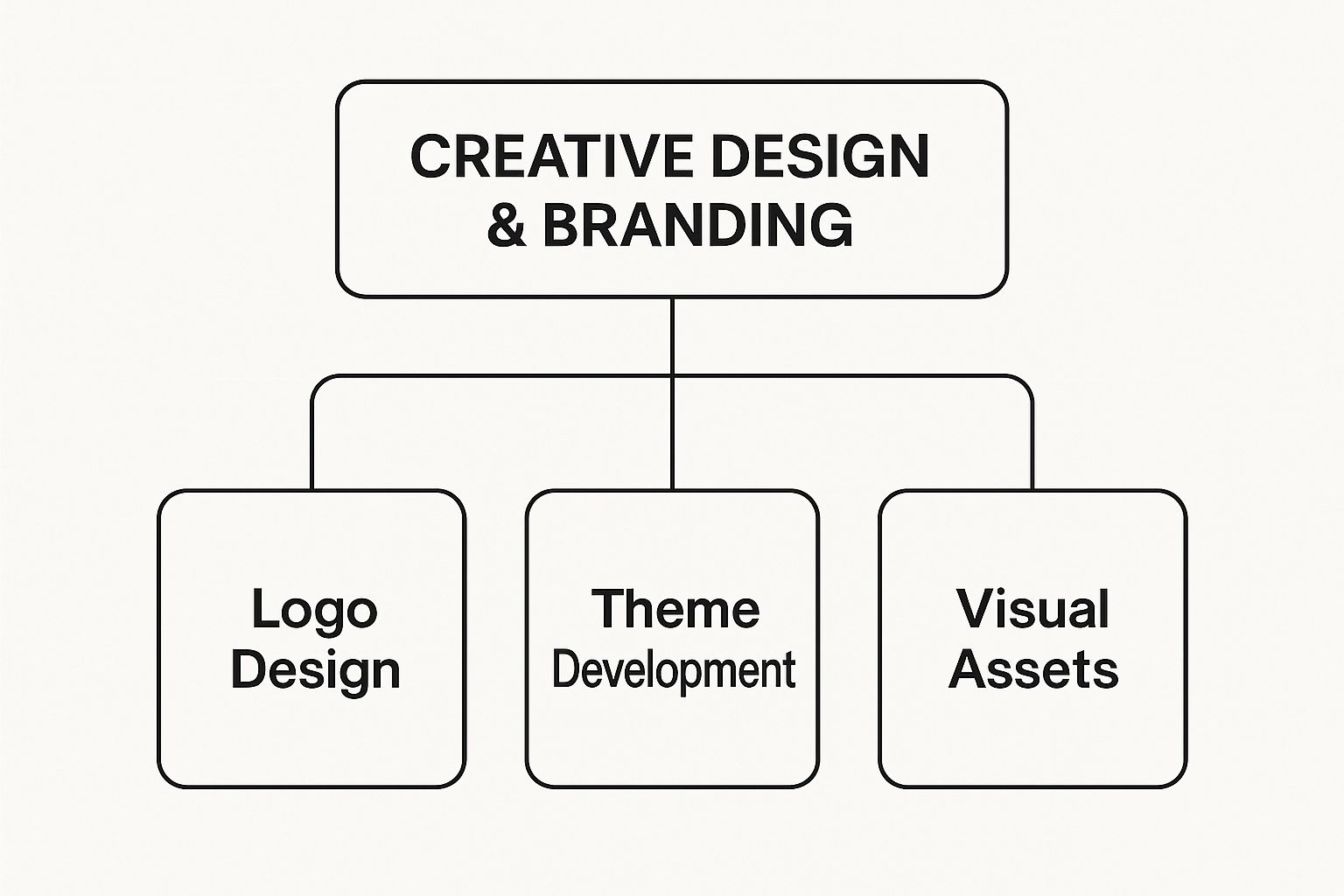
This diagram shows how a central theme is supported by consistent logo usage and visual elements, creating a unified brand experience.
Stylists work with a huge inventory of props, custom decor, floral arrangements, and furniture to bring a vision to life. A comprehensive approach to theming by experienced events production services ensures that every element, from the table centrepieces to the entryway decor, contributes to a single, powerful narrative that leaves a lasting impression.
The Unseen Engine of Event Logistics

While dazzling lights and crystal-clear sound grab all the attention, the real foundation of a flawless event is built long before the first guest even thinks about arriving. This is the world of event logistics, the unseen operational powerhouse that makes everything else possible.
Think of it as mission control for your event. It’s a hub of meticulous planning and coordination that runs silently in the background, orchestrating hundreds of moving parts, from managing suppliers and crew schedules to making sure every single piece of equipment arrives on time. Every seamless moment your audience experiences is a direct result of this disciplined, behind-the-scenes mastery.
This unseen effort is a huge driver of the UK’s booming event scene. The UK’s events, conference, and exhibition sectors recently added around £10.9 billion to the economy, a massive 17% increase from the previous year. This growth is built on an industry that hosted 1,016 exhibitions drawing nearly 7 million visitors.
Pre-Production Planning: The Blueprint for Success
Long before a single flight case is loaded onto a truck, the logistics team is deep in pre-production planning. This is where the entire event gets mapped out on paper, creating a detailed blueprint for every action that will follow. It’s a non-stop process of asking “what if?” and “how?” to get ahead of challenges and engineer solutions before they become problems.
But this phase is so much more than a simple to-do list. It’s about creating a comprehensive operational plan that covers every conceivable contingency.
The goal of pre-production isn’t just to plan for what you expect to happen, but to build a resilient framework that can handle what you don’t. It’s the strategic foresight that transforms potential chaos into controlled execution.
Effective logistics depend entirely on meticulously planned project timelines. Every task, from booking the venue to confirming suppliers, is plotted on a master schedule. This ensures all the dependent parts are managed and deadlines are hit without fail. For anyone looking to get better at this, there are some excellent guides on creating robust project timelines that can help a manager master this critical skill.
Supplier and Venue Coordination
No event is an island. Its success relies on a whole network of external partners, including venues, caterers, security firms, and equipment hire companies. A key role of events production services is to act as the central point of contact, expertly managing all these moving parts.
This involves:
- Vetting and Negotiation: Sourcing and selecting reliable suppliers who can meet the specific technical and creative demands of the event, then negotiating contracts that work with the budget.
- Venue Liaison: Working hand-in-glove with the venue’s in-house team to understand their rules, power capabilities, loading procedures, and emergency protocols for seamless integration.
- Scheduling and Briefing: Coordinating arrival times, setup windows, and teardown schedules for all third-party vendors to avoid bottlenecks and operational clashes on-site.
This intense coordination ensures that all external teams work like a single, cohesive unit, all reading from the same playbook to deliver the event’s goals.
Risk Assessment and Safety Compliance
Perhaps the most critical yet least visible part of event logistics is the relentless focus on safety. Professional production companies are legally and morally responsible for the well-being of every single person on site, from the crew and performers to every last attendee. This responsibility is handled through rigorous risk assessment and strict adherence to health and safety regulations.
This proactive process means identifying potential hazards and putting control measures in place to mitigate them. Common areas of focus are:
- Structural Safety: Ensuring all staging, rigging, and temporary structures are built to professional standards and can safely support their intended loads.
- Electrical Safety: Managing power distribution to prevent overloads and making sure all cabling is safely routed to eliminate trip hazards.
- Crowd Management: Developing solid plans for safe audience flow, entry and exit procedures, and emergency evacuations in coordination with venue security.
Ultimately, this unseen engine of logistics provides the structure, safety, and stability that allows creativity to flourish. It’s what makes sure your event is remembered for all the right reasons.
How Professional Production Elevates Your Event
Deciding between a DIY approach and hiring events production services isn’t just about saving a bit of hassle. It’s a fundamental choice that shapes your event’s impact, message, and ultimately, its success. Bringing in the experts elevates the entire experience, transforming what could be a stressful scramble into a polished, memorable occasion that genuinely delivers.
Imagine two corporate product launches for similar tech companies.
The first is managed in-house by a well-meaning but completely swamped marketing team. Little things start to go wrong. A presenter’s microphone keeps crackling and cutting out. The branding on the main screen looks fuzzy and pixelated. The lighting is harsh and stark, making a beautiful venue feel cold and unwelcoming.
Now, picture the second launch, this one handled by a professional production firm. The moment guests arrive, they’re greeted by a stunning, custom-branded entryway. Inside, the lighting is soft and dynamic, subtly shifting to highlight key moments. Every video plays flawlessly on a massive LED wall, and the sound is so crisp you can hear every word, even in the back row.
The difference isn’t just technical; it’s emotional. One event feels disjointed and amateur. The other feels confident, impressive, and professional.
Access to Expertise and Technology
This difference really comes down to three things professional firms bring to the table: specialised skills, high-end technology, and priceless experience. Your internal team might be brilliant at marketing or sales, but they probably aren’t experts in sound engineering or structural rigging. Production specialists live and breathe this stuff every single day.
They bring deep knowledge of what works from knowing the exact microphone for a panel discussion to understanding how to design a stage that’s both striking and safe. Plus, they own or have access to top-tier equipment that would cost a fortune to rent or buy for a one-off event. This means you get the best tools for the job without a crippling capital outlay.
A professional production company doesn’t just rent you equipment; they provide the expertise to wield that equipment with purpose. They turn technology into a tool for storytelling, ensuring every element serves the event’s core message.
DIY vs Professional Event Production: A Comparison
So, what does this look like in practice? When you’re weighing the options, it helps to compare the potential outcomes directly. Going it alone can seem like a cost-saver, but the hidden costs in time, stress, and missed opportunities can quickly add up.
| Aspect | DIY Approach | Professional Service |
|---|---|---|
| Technical Execution | Often inconsistent; relies on basic equipment and limited knowledge, leading to glitches. | Flawless and polished; uses high-end gear operated by certified specialists. |
| Guest Experience | Can feel disjointed or amateur, distracting from the core message. | Immersive and seamless, keeping attendees engaged and focused. |
| Risk Management | Limited contingency planning; a single issue (e.g., power outage) can derail the event. | Comprehensive risk assessments, backup systems, and experienced problem-solvers. |
| Brand Perception | Risks making the brand appear unprepared or unprofessional. | Reinforces a brand image of quality, confidence, and excellence. |
| Team Focus | Internal teams are stretched thin, juggling their primary roles with unfamiliar production tasks. | Your team can focus on guests, content, and networking, leaving logistics to the experts. |
| Overall Impact | The event happens, but it may not achieve its strategic goals or leave a lasting impression. | Creates a memorable, high-impact experience that delivers a clear return on investment. |
Ultimately, hiring professionals isn’t an expense it’s an investment in your event’s success and your brand’s reputation.
Reducing Risk and Maximising Impact
Bringing in an expert team is also a smart risk management strategy. They run thorough risk assessments, ensure every health and safety regulation is met, and have contingency plans for when things go wrong because sometimes, they do. A power cut or equipment failure that would derail a DIY event is just another problem for a seasoned production crew to solve.
This gives you the peace of mind to focus on your guests and your goals, rather than firefighting technical glitches. Beyond logistics, professional production is about crafting immersive experiences. Exploring innovative experiential marketing strategies can completely change how attendees engage, whether they’re in the room or joining online.
In the UK, creating this powerful connection is crucial. Despite virtual options, 95% of exhibitors still favour in-person events, which pull in around 85 million attendees each year across the country.
By creating a flawless and engaging atmosphere, professional production services ensure you make an unforgettable impression on every single person there, cementing your brand’s reputation for quality and excellence. This is what turns attendees into advocates and delivers a return far beyond the ticket price.
How to Choose the Right Production Partner

Picking the right company for your events production services is easily one of the most critical decisions you’ll make. This choice is about so much more than comparing price tags; it’s about finding a true creative and technical partner who gets your vision and has the chops to bring it to life without a hitch.
Think of it like casting the lead role in a play. You wouldn’t just hire the cheapest actor you could find. You’d look for someone with the right experience, a portfolio that clicks with the role, and a collaborative spirit. The same logic applies here. You need a partner whose expertise is a perfect match for your event’s goals, whether that’s a corporate conference, a high-energy brand activation, or an immersive product launch.
Look Beyond the Showreel
A polished showreel or a glossy brochure is a great start, but it only tells you half the story. To make a smart decision, you have to dig deeper into a company’s portfolio and look for specific, relevant experience. Don’t get distracted by a stunning concert video if what you’re planning is a sophisticated corporate gala.
Instead, put on your detective hat and analyse their past work:
- Relevance: Have they actually produced events of a similar scale, type, and complexity to yours?
- Creativity: Does their work feel genuinely fresh and original, or does it all follow a predictable formula?
- Execution: Look for proof of high production values. Do their case studies show sharp attention to detail and a seamless, professional finish?
This forensic look at their history paints a much clearer picture of their real capabilities than any highlight reel ever could. It shows you not just what they can do, but how they think and solve creative problems.
Assess Communication and Project Management
A production company’s creative genius is worthless if their communication is a mess and their project management is chaotic. Pulling off a successful event is a deeply collaborative dance, and you absolutely need a partner who is organised, transparent, and responsive.
Before you sign on the dotted line, get a feel for how they operate. Are they proactive with their updates? Do they actually listen to your ideas and concerns? A great partner will make you feel heard and confident throughout the entire process, not just during the initial sales pitch. When you’re sizing up a potential partner, understanding how much event planners charge is also a crucial step in budgeting, helping you align your expectations with what the market dictates.
“The relationship with your production partner is just that a partnership. Success depends on shared vision, open communication, and mutual trust. Choose a team that feels like a natural extension of your own.”
Finding a team whose project management style clicks with yours is key to a stress-free experience. A company like Boo Productions, for example, champions a collaborative, concept-to-completion approach, making sure the client is looped in and informed from the first 3D visualisations to the final on-site execution.
Key Questions to Ask Potential Partners
To cut through the marketing fluff and get to the heart of what a company can really deliver, you need to ask the right questions. These are designed to uncover their processes, problem-solving skills, and true depth of experience.
Here’s an essential checklist to guide your conversations:
- Can you walk me through your creative process, from the initial concept to the final design? This reveals how they turn ideas into reality and how collaborative they truly are.
- How do you handle unforeseen on-site challenges, like equipment failure or sudden weather changes? Their answer will tell you everything about their experience and preparedness. A seasoned team will already have contingency plans.
- Who will be my main point of contact, and what does your team structure look like? This clarifies who you’ll be working with day-to-day and sets clear lines of communication.
- Can you provide detailed case studies or references from clients with events similar to mine? This is your chance to verify their claims and hear directly from people who’ve been in your shoes.
- How do you ensure health and safety compliance on-site? A professional company will have strict safety protocols and won’t hesitate for a second to share them.
Asking these direct, practical questions empowers you to look past the surface and choose a production partner with real confidence, ensuring your event is not only spectacular but also safely and professionally managed from start to finish.
Common Questions About Production Services
Stepping into the world of professional event production for the first time can feel a little daunting. There are new terms to learn, new roles to understand, and budgets to figure out. It’s completely normal to have questions.
To clear things up, we’ve pulled together some straightforward answers to the questions we hear most often about events production services. Think of this as your practical guide to navigating the planning journey with confidence, so you know exactly what to expect when you bring in the experts.
How Far in Advance Should I Book?
This is one of the most important questions, and the answer really comes down to the scale and complexity of your event. For a big, ambitious project like a multi-day conference or an elaborate brand activation you’ll want to book your production partner 6 to 12 months in advance.
That lead time isn’t just about getting on their schedule. It’s crucial for meticulous planning, building custom sets, sourcing specialised equipment, and locking in the best crew. For smaller events, like a single-day meeting or a private party, a lead time of 3 to 6 months usually does the trick. The golden rule? The sooner you start the conversation, the more creative and logistical doors will be open to you.
Planner vs. Production Company: What’s the Difference?
It’s easy to mix up the roles of an event planner and a production company, but they actually look after very different parts of an event. A good analogy is building a house: the planner is the architect designing the overall experience, while the production company is the master builder who brings the physical structure to life.
- An Event Planner focuses on guest-facing logistics. They handle things like invitations and RSVPs, marketing, catering, delegate travel, and the overall budget. They’re concerned with the who, why, and where of the event.
- An Events Production Company handles the technical and creative execution. They’re all about the tangible, sensory elements the audio-visuals, lighting, staging, set design, and immersive theming. Their world is the how: how the event will look, sound, and feel.
While their roles are distinct, the magic truly happens when the planner and production company work hand-in-glove, turning a shared vision into a seamless reality.
Can You Work With Our Chosen Venue?
Absolutely. In fact, a key strength of any seasoned production company is its ability to adapt and integrate. Professional teams are built to collaborate not just with clients, but with venue managers, in-house technicians, and other suppliers.
A professional production team doesn’t replace a venue’s staff; they become an extension of it. The goal is to create a unified team working towards a single, flawless execution, leveraging the venue’s unique features to their fullest potential.
Before any equipment arrives, the production team will do a thorough site visit. They’ll assess everything from power capabilities and loading access to rigging points and safety protocols, ensuring everything runs like clockwork on the day.
How Are Your Services Priced?
Demystifying the cost of events production services is key to transparent and effective planning. Your final investment is a blend of several core components, each contributing to the quality and scale of the experience you’re creating.
Your quote will typically be broken down into these four areas:
- Equipment Hire: The cost for all the technical gear, from sound systems and projectors to lighting rigs and video walls.
- Crew Labour: The fees for the skilled technicians, designers, and project managers who design, set up, operate, and take down the event.
- Custom Fabrication: The cost for any bespoke elements, such as custom-built stages, branded backdrops, or unique props made in a workshop.
- Design and Management Fees: A charge that covers all the pre-production planning, creative concept work, and project management needed to pull everything together.
Understanding this structure helps you see exactly where your investment is going and appreciate the value each part adds to your event.
Ready to create an immersive experience that captivates your audience? The team at Boo Productions combines creative storytelling with flawless technical execution to bring your vision to life. Contact us today to discuss your next event.